
Drills vs Games
How to choose and evaluate activity design

A question I get frequently is when a team should use games and when should they use drills. It is a difficult question to answer because it depends on a lot of factors - it’s not a case of doing 60% games and 40% drills or anything as simple as that. It’s really important in the first place that when trying to assess what type of activities are best for your team that you have a clear idea of what the objectives are.
Note at this point: I have started referring to the different things I put into my sessions as ‘activities’ rather than saying drills or games.
What is a drill and what is a game
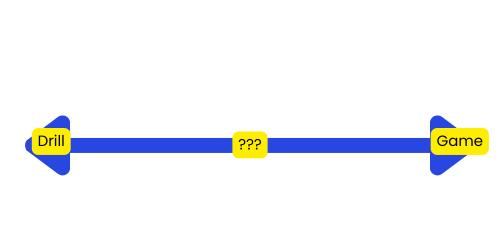
The extremes here are pretty obvious – the ever popular 4 lines is a static setup with a single designed outcome and we’re all going to recognise that as a drill. An set of 5 pull 1 possession 7v7 reps is clearly game based. However, there is a very large middle ground between these that is less clear.
You can have activities with a completely static setup and single goal or pattern but it’s played 7v7 until a score or turnover - a lot of teams practice redzone this way. Is that a game because it’s 7v7 with goals being scored and everyone making choices and reading the spaces and so on - or is it a drill because it’s a static setup with a single outcome and a directive to run a particular pattern? It doesn’t really fit neatly into either category and that’s OK. You can tie yourself in knots trying to figure out if a certain activity is a drill or a game, but it really doesn’t matter.
What does matter: does the activity choice best serve the needs of the team. Each team has it’s own needs and environment so, unhelpfully, there’s no one solution. Having said that, I bang the drum for a game based approach a lot and it’s because I think most teams default for an activity is ‘what drill can we run’ and I think the default should be ‘what game can we run’. A bad game is better than a bad drill and a good game is better than a good drill.
Games and Constraints Led Approach
There is also a tendency in discussions – and I’m as guilty of this as anyone – to merge a game based approach and the constraints led approach together. But really these are separate lenses through which to examine activity design. You can have a game which has no constraints, and you can have drills which do have constraints.
I personally really like trying to do as much as possible through games, and a big advocate of using constraints to invite players to come up with solutions. So I’m always trying to create an activity which is game based (with goalscoring) and has a high level of constraints. But they are separate ideas and so you can have one without the other.*
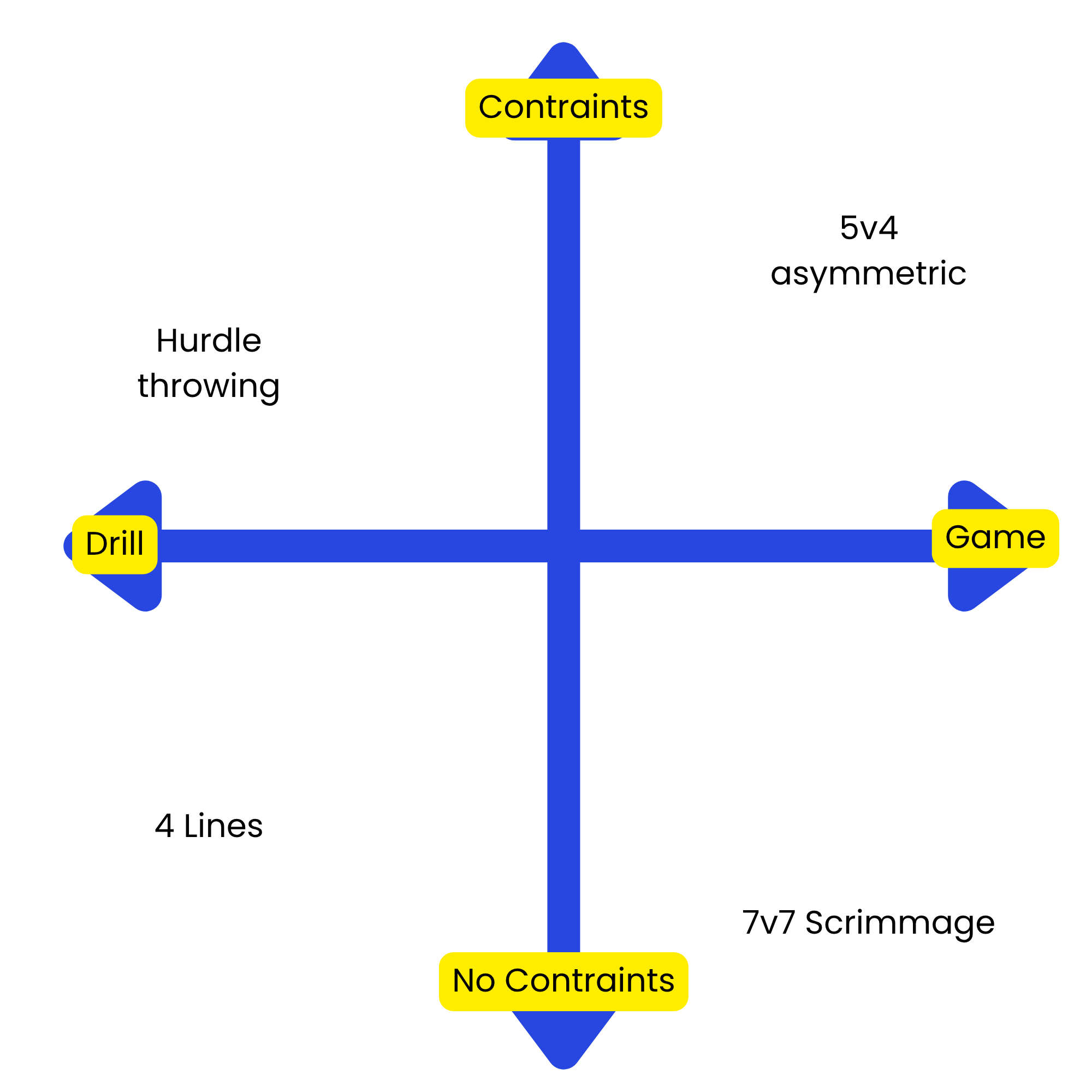
We can plot this on an axis – where you fall on the scale of drills vs games, and where you fall on the scale of constraints.
The top right – game based, with constraints in my experience generally produce the best long term results for teams and individuals.
The bottom left – drills with no constraints generally produce the worst results (and are usually quite dull for both coach and player)
A game with no constraints is usually very enjoyable for players (which may or may not be something important to you) and also necessary to check progress
Drills with constraints are very productive teaching tools, particularly for individual technical areas
*which is also the answer to another question I get asked a lot – can you use the CLA to work on skills individually – yes, of course you can. Someday I’ll write about that properly.
Recent CLA news
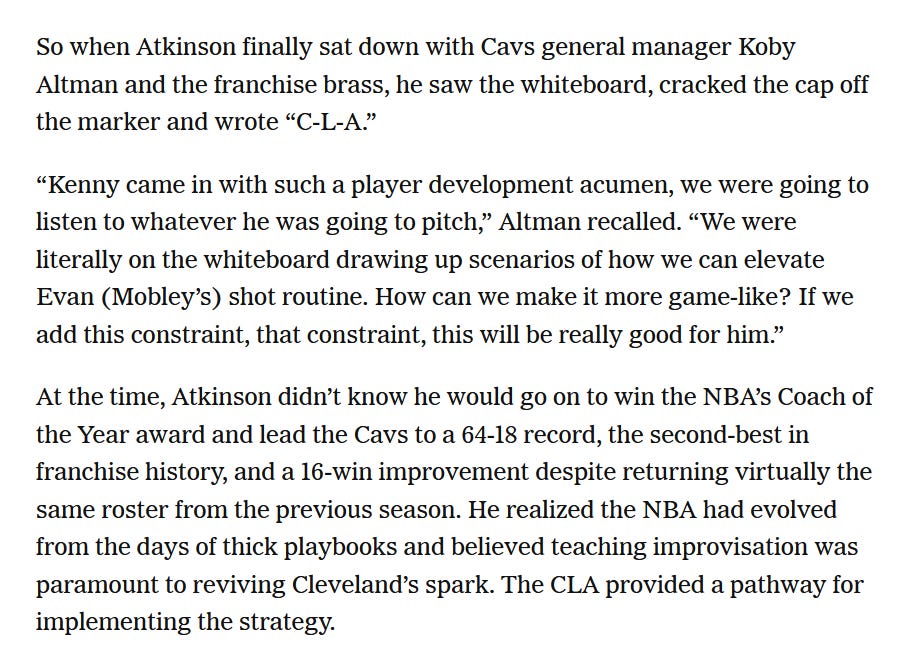
https://www.nytimes.com/athletic/6665943/2025/09/29/sports-training-cla-coaching-wembanyana-ohtani/
Fun to see this pop up on my Athletic homepage on the app last month. A good read into the growing popularity of the CLA amongst coaches of top athletes.
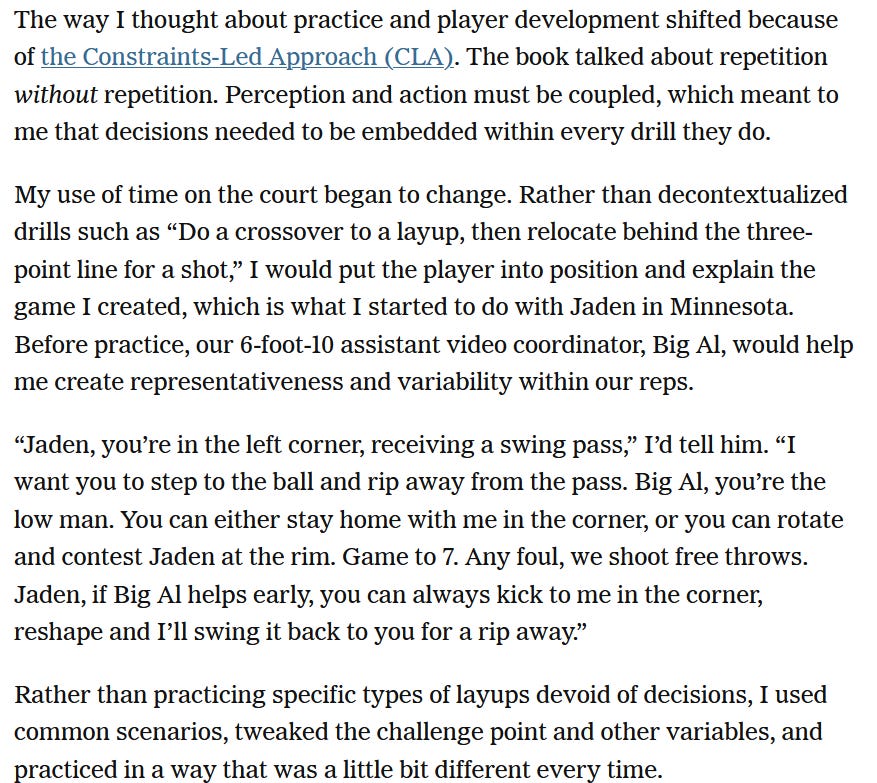
https://www.nytimes.com/athletic/6720046/2025/10/16/nba-player-development-training-techniques-timberwolves-pelicans/
Another excellent CLA piece in the Athletic
This is great. Since reading your book, we’ve been doing a lot of games with constraints. I’m having trouble understanding drills with constraints. Can you unpack that a bit more or give a couple more examples? I don’t know what hurdle throwing is. Thanks!